
|
Getting your Trinity Audio player ready...
|
On Mohawk civil liberties, and whether Canada owes them anything
For twenty-four years it was a crime in this country for an Indian to hire a lawyer.
Not a figure of speech. In 1927 Parliament added section 141 to the Indian Act, making it an offence to receive or solicit money from an Indian for the prosecution of a claim without the written consent of the Superintendent General. It stayed on the books until 1951. The state that had taken the land made it an offence to fund the case to get it back.
I raise it because of an objection I hear often, usually sincerely meant: if the Haldimand claim were any good, somebody would have brought it long ago. That objection has an answer, and the answer is a statute. For a quarter of a century, trying was the offence.
Civil liberties here came down a particular chain — Magna Carta, the common law courts, the Bill of Rights of 1689, and much later than people remember, the Charter. Each is a settlement between a Crown and its own subjects, about how one political community’s government would treat its own people.
The Kanien’kehá:ka were never inside that community. We were beside it.
In April of 1710 four sachems of the Confederacy — three of them Mohawk — stood before Queen Anne at St James’s. They told her they had been, in the war against the French, “as a strong wall for their Security, even to the loss of our best men,” and that they rejoiced to hear she had resolved to send an army “to reduce Canada.” They gave her belts of wampum.
In 1710 Canada meant New France. Canada was the enemy. The Mohawk did not cross the Atlantic to be let into Canada. They asked the Queen of England to conquer it, then fought that war and lost their best men in it.
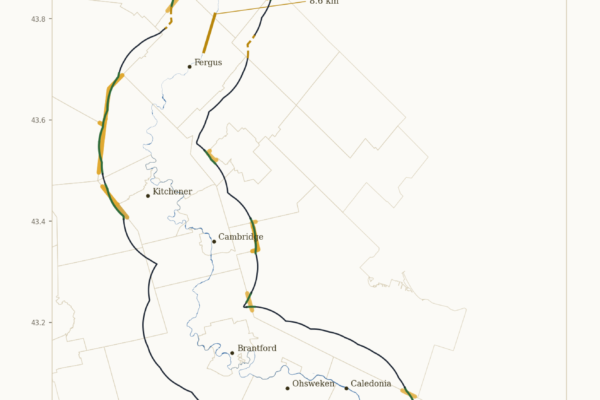
Seventy-four years later the same Crown, for the same alliance, set apart six miles deep on each side of the Grand River for the Mohawk Nation and their posterity, to enjoy for ever.
So if our liberties did not come down the Canadian chain, where do they come from — and did we ever agree to give them up?
That assumption sits underneath every interaction. When a registry office says there is no mechanism to record a Crown grant, the assumption is that somewhere, at some point, we agreed.
The law’s test for waiver is settled. You must know you hold the right, give it up voluntarily, and have the capacity to give it up at all.
In October of 1924 the Royal Canadian Mounted Police entered the Council House at Ohsweken, removed the Confederacy chiefs, and seized the wampum. An elected council under section 74 of the Indian Act was installed in their place. Nobody voted to end the Confederacy. It was ended by armed men under an order-in-council. That is a taking, not a waiver. Three years later came section 141.
Section 141 was repealed in 1951. Consider what happened when the bar came off.
The first case to reach a court afterwards was Logan v. Styres, decided by Mr Justice King of the Ontario High Court on 3 September 1959. The hereditary chiefs argued the Six Nations were outside the reach of the British North America Act and that the Indian Act did not apply. King J. rejected it, on reasoning that is the whole difficulty in one line: by accepting the protection of the Crown, the Six Nations owed allegiance to it and thus became subjects.
Protection, therefore allegiance, therefore subjects, therefore no longer allies.
Set that beside 1710. A people who cross an ocean to tell a Queen they have been a wall for her security, and to ask her to send an army against Canada, are not seeking protection. They are supplying it. Whatever King J. was describing, it was not what happened at St James’s.
And look at what the word protection meant when the Crown used it. The Royal Proclamation of 1763 provided that the nations with whom the Crown was connected “should not be molested or disturbed in the Possession” of lands reserved to them. Protection there was protection from interference. It was a shield held over us, not a claim upon us.
By 1959 the word had been turned inside out. What the Crown offered as protection from molestation was read as submission to authority. On that reading every subsequent exercise of power over us becomes lawful — not because anything was agreed, but because we were within reach.
Proximity is not jurisdiction. Absent a waiver or a treaty, an arrest is not authorised by the fact that the person arrested was standing nearby. Molestation is the older word for it. Arbitrary is the modern one.
Fourteen years later the argument was put again and it worked. In Isaac v. Davey, Mr Justice Osler of the same court held that the Simcoe Patent conveyed a fee simple, and that in consequence the band and reserve machinery of the Indian Act had no valid foundation on these lands. The elected council installed in 1924 was invalid.
That was 1973 — the only occasion on which a Canadian court, looking at the instruments, has said what the record shows.

It did not survive. The Court of Appeal reversed the following year, re-reading the same instrument as conveying not ownership but a personal and usufructuary right. When the case reached the Supreme Court in 1977 that Court dismissed it without construing the Patent at all, resting instead on a trust fund — monies held since 1835, from transactions having nothing to do with Haldimand or Simcoe.
Our own money, held by the Crown, became the reason the Crown’s own instruments never had to be construed.
The bar came off in 1951, but something has grown up in its place.
There is a real body of pseudolegal argument in the Canadian courts. Its practitioners issue themselves documents, invent registries, deny the jurisdiction of the rooms they stand in, and some claim Indigenous status they do not hold because the vocabulary of sovereignty is convenient. Courts have learned to spot it, and are right to.
The consequence for us is direct. Two legal scholars put it plainly last year: this material damages Indigenous peoples by undermining their efforts to obtain recognition of their own laws. A court trained to recognise the counterfeit is quicker to suspect the genuine. The forger discredits the signature.
So a Mohawk who raises the Haldimand instruments now risks having the argument disposed of by label rather than answer — pseudolaw, frivolous, vexatious, an abuse of process. Struck before it is heard. Reduced to a nuisance.
Follow the whole of it. From 1927 to 1951 the argument was barred because funding it was a crime. In 1959 it was answered by holding that protection had made us subjects. In 1973 it succeeded, and was reversed on a ground that never touched the instruments. Since then it is barred because raising it is treated as a symptom. Four mechanisms, and under none were the instruments construed.
One more piece settles the capacity question. In 1923 Levi General, Deskaheh, petitioned the League of Nations for recognition of the Six Nations. He was refused, and the reason Canada gave is the part to keep: Indians in Canada were not to be recognised as international political actors. They were wards of the state, in need of civilising and federal protection.
One year later the Council House was cleared. Four years after that, funding a claim became a crime.
You cannot have it both ways. A people cannot be too incapable to appear at Geneva and simultaneously capable of surrendering their legal order. Wardship and waiver are opposites — the whole point of a ward is that a ward cannot alienate. Sovereignty here is not a thing to be won. It is a thing that was never handed over.
One document settles it more neatly than any argument I could make. On 6 March 1922 a member rose in the House of Commons at Westminster and asked when, and by what parties, the Haldimand Treaty had been denounced. The reply named no date, no party, and no instrument.
A government that cannot say when a promise ended is not in a position to say it is over.
Which brings me to the question I want to put to my neighbours rather than the Crown. Do Canadians, and does the rule of law here, owe any obligation to Mohawk civil liberties as distinct from their own?
Yes — and it is an obligation Canada took on itself.
Section 109 of the Constitution Act of 1867 gave the provinces their lands. It did not give them clean lands. It gave them lands subject to any trusts existing in respect of them, and to any interest other than that of the province in the same. The act that created Ontario expressly contemplates interests in this ground which do not come from Canada and are not held by Canada. It does not define or limit them. The province takes subject to them.
Section 129 continued the courts, officers and laws existing before Confederation. The legal order did not restart in 1867. It carried.
And every officer here swears allegiance to the Crown, not to a person. The Court of Appeal has held the oath is sworn to the institution and to the constitutional structure the Crown represents. You cannot swear to the whole and then decline the parts you had not heard of.
Canadians do not owe Mohawk liberties respect because we are asking nicely. They owe it because their own constitution says the land came to them encumbered, their own oath binds their officers to the structure that encumbered it, and their own Parliament has never named the day it ended.
Three hundred and sixteen years ago four men crossed an ocean to tell a Queen what they had done for her and what they expected in return. Nobody has produced the document in which their descendants agreed to be governed by the country they helped her take.
We were the wall. We lost our best men holding it. And we never agreed to be inside it.
Originally published in the Two Row Times, September 2, 2026 (Volume 14, Issue 3), page 6.