
|
Getting your Trinity Audio player ready...
|
At the end of this month the country observes the National Day for Truth and Reconciliation, and because Ontario has not made it a statutory holiday, most children here will spend it in a classroom, at an assembly, learning about what was done to children in classrooms. Nobody designed that. It falls four weeks into the school year, every year, and it will fall that way again on the thirtieth.
The observance is built around a shirt. Phyllis Webstad was six years old when her grandmother bought her a new orange shirt for her first day at the mission school in Williams Lake. The staff took it from her and she never got it back. That is a true story, it belongs to her, and she has carried it generously for years. But look at what the country did with it. Of everything taken from Onkwehón:we children over a century and a half, Canada selected the one item that can be reproduced at scale and worn. A shirt can be bought at a grocery store on the twenty-ninth. It lets a person who has lost nothing participate fully and visibly, for about twenty dollars, and be photographed doing it.
I am not going after anyone who wears one. Teachers wear them sincerely and children wear them because they were told to. The shirt is not the problem. The substitution is. What was taken in that building on Mohawk Street was not clothing. It was Kanien’kéha, the ability of a grandmother to say something to a child in the kitchen and be understood. You cannot wear that. There is no orange version of it available to a person who does not have it, which is precisely why the country settled where it did. Canada chose the one loss that could be made wearable, wears it once a year, and calls the account current.
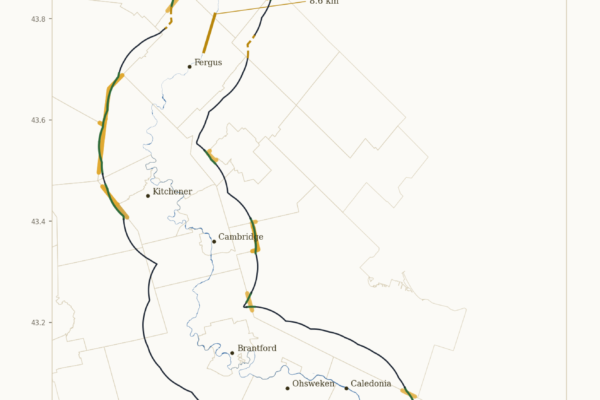
I have spent a great deal of my life on paper. Haldimand, 1784, six miles deep on each side of the Grand, granted to the Mohawk Nation and to their posterity, to be enjoyed forever. I believe that instrument binds the Crown and I intend to keep saying so. But I would be lying if I told you paper alone has ever held. That is the most explicit written promise the Crown ever made on this river, and look at the map now. What binds the Crown is a nation still standing on the other side of the paper, able to read it, insist on it and outlast the delay. That is the whole enforcement mechanism, and it is not manufactured in a courtroom. It is manufactured in a room with twenty children, a tired teacher and a fluent speaker who is seventy-eight years old.
Which is why what happened after the Institute closed matters as much as what happened inside it. The building shut and the work changed departments. Children who would have been sent there went into care instead, placed by an agency into homes chosen by strangers, under a system that never had to explain itself to a clan mother. The country files that under the Sixties Scoop, as though it ended when the decade did.
And here is the part nobody here wants said out loud. This did not only happen to us. Some of it was authorized here. Council sanctioned the arrangement and had a hand in processing the cases, and the resolutions exist.
I am not writing that to shame anybody, and I have no interest in the version of this story where we spend twenty years arguing about who signed. Think about what the Indian Act actually is. It created the council, set what it could and could not decide, and held the budget. Then it handed our children’s files across the table and asked for a signature, and it got one, the way it was always going to. Put a people in a room with no other exit and you can get almost any door opened from the inside. That is not consent. That is architecture. And a system built that way buys itself something it could never have won honestly, which is eighty years of us looking at each other instead of at it.

Refusing to blame each other is not the same as refusing to look. A child belongs to her mother’s clan. That is not sentiment here. It is law, and it is how a name, a house and a responsibility travel through time. When a Turtle child was raised in a Wolf home, or a Kanien’kehá:ka child in a Gayogo̱hó:nǫ’ home, or a child taken and placed in “foreign” Canadian homes, the transmission was cut in all three cases. We tend to count only the third, because in the first two she stayed with us. She stayed on the territory. She did not stay in her line, and the line is the part that carries. A woman in her sixties who cannot say which longhouse she belongs to knows exactly what was taken, whatever the file called it.
And it does not take an agency. Transmission breaks in quieter ways, and every organization here knows how. There is one woman who knows how the roll was kept. One man with the binders in his basement and the whole chain of it in his head. One speaker who has never been recorded. Not because we are careless. Because she is doing five people’s work on funding written for one. Because he has been carrying it alone since the people who should have been carrying it beside him were sent away. Because there is money in this country for a ceremony on the thirtieth and none for a recording studio in October. We are not a forgetful people. We are an understaffed one, and the staffing level is set in Ottawa by the same department that ran the school.
The Crown has one real advantage over us and it is not virtue. It never dies. It is built to need no particular person, so any clerk can pick up the file, and it can lose a whole generation of its own staff without losing a day of institutional memory. We have never been resourced to build anything like that, and then we are asked why our organizations are fragile. Still, the test is worth putting to every one of ours, mine included. If the person who runs this were gone next month, could someone else open the cabinet and carry on? Where the answer is no, that is not a character flaw. It is an unfunded position, and it is on a timer.
So the work this fall is the ordinary kind. Record the speaker now rather than next year. Copy the files and give the copy to somebody younger. Sit a nineteen-year-old beside you and let them do it badly for a year until they do it well. Teach the child the words even if your pronunciation is poor and let them correct you, which they will enjoy far more than you will. None of that is penance. It is what a nation does while it waits for a debt to be paid, and every hour of it is an hour we spend covering for someone else.
So on the thirtieth, wear what you like. But if you want to know whether this country is reconciling, do not count shirts and do not look at the flags at half mast. Count speakers. Ask how many people on this territory could hold a conversation in Kanien’kéha a year ago and how many can now, and ask what was spent to move that number. That is the whole scoreboard, and nobody has been asked to report it.
To the Crown I will say what I always say. Posterity is your word. You wrote it in your own hand in 1784 and you have had two hundred and forty-two years to work out what it obliges you to do. We will keep producing children who can read what you wrote, in your language and in ours, for as long as that takes, and we will do it on what you have left us. You may wait as long as you like. So can we, and we have the better reason.
Originally published in the Two Row Times, September 9, 2026 (Volume 14, Issue 4), page 6.