|
Getting your Trinity Audio player ready...
|
A man in Brantford fills a glass at his sink without a thought. Out here a truck comes up a driveway in the dark, a hose goes over, a cistern fills under the yard, and every child in the house knows the hollow note the tank makes when it is nearly empty. When the delivery is late, or the pump quits, or the money is thin that week, a household does arithmetic nobody teaches in school. How many showers are left in the tank. Whether the laundry holds until Thursday. Children here run that math by about eight, and once they can they start making decisions with it. They stop asking to have anyone over. They decide, with nobody prompting them, that they are not really a basketball person after all, because practice ends in a change room and the day ends in a tank. None of it appears in a report on educational outcomes. There is no column for it. Both households are drinking the same river.
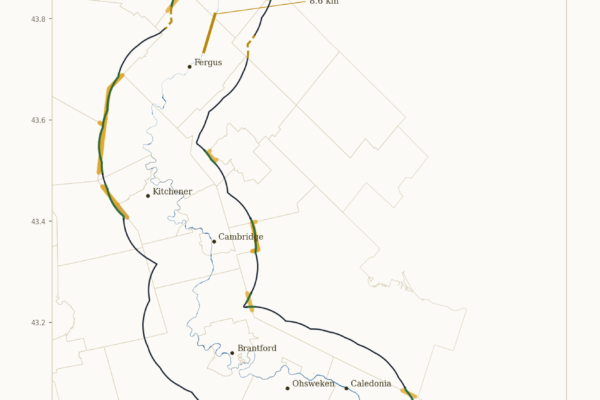
Nobody reading this needs the measurements read back to them. What is worth saying out loud is the thing sitting inside them. The Crown had no other unit to work with in 1784. Not acres, not townships, not lots. It measured us in river. That makes the Grand something other than a feature of the territory. It is the medium the arrangement was written in, and every argument we have made since is an argument about water whether we call it that or not.
Follow it now. Past Kitchener, past Waterloo and Cambridge, through Brant County and Brantford, then through us, then Caledonia and Cayuga and Dunnville, then Erie. Towns drink it. Farms draw from it. In August the golf courses drink it and the greens stay the colour of money. Every one of those users stands on ground measured outward from that same water, and none has to think about the tap. That is what an entitlement looks like when it works. They have ours.
And each of those towns sends something back. The Grand carries treated effluent from a chain of municipal plants, and by the time it reaches us it holds the discharge of the whole upper watershed. We are not the last community on the river. We are the one below every city on it. They did not receive that land. They took it, by lease that never came back, by surrender nobody can produce, by sale written up in our name by people we never authorized to sell anything. Then they took the water, and what reaches us is what is left after they have finished with it.
They used our money to do it. Funds taken into the Indian Department’s custody were put into the Grand River Navigation Company, which dredged and locked this river for the towns upstream, and nobody here was asked. The company failed. The money never came back. The works went for nominal sums, a dollar in places, and the locks and landings passed into other hands, some of them municipal. So we financed the improvement of the river for the people who now hold the taps on it, on a venture chosen by the same administration that was selling our land to the towns it served.
Here, in the community named for the river, many houses have no line at all. There is a plant. It was built, opened, photographed, and by every measure it makes clean water. The pipe to carry that water to the door was another question, because pipe is buried and boring and cannot be attended. Nothing opens. Nobody cuts a ribbon over a trench in November. So the plant runs, the houses wait, and the trucks keep coming up the driveways.
What follows does not announce itself as water, which is why none of it has ever been counted. Start with fire. No line, no hydrant. No hydrant, no pressure. No pressure, and a volunteer crew shuttles tankers while the walls go, and everyone here can name the family and the road and the year. The rest arrives later, in an envelope. A property beyond a set distance from a hydrant is rated differently, sometimes not written at all. No insurance, no financing, and the land underneath cannot be mortgaged either. So the family does not rebuild. They double up or they go. Doubling up is overcrowding, and overcrowding brings an agency to the door and puts a child’s name on a file. A missing pipe ends, by a route nobody traces, where the wagons used to.

Then count what cannot be built. A kitchen needs pressure and a grease trap. So does a bakery, a laundromat, a licensed daycare. Across most of this territory those are impossible for a reason that has nothing to do with will or wit or work, so the money drives to Brantford. Groceries, lunch, laundry, the daycare that lets a mother take a shift. It leaves on the same road every morning and does not come home, and over fifty years it is a fortune. The missing economy is then read back as a finding about our character.
Then the loss I care about most, which no longer looks like water by the time it happens. Young families go. Not over politics, not because they stopped being who they are. They go because a house in Brantford has a working tap and a hydrant on the corner and a licensed daycare, and because they are tired, and because the baby needs a bath. What leaves is never just a household off a roll. It is a clan line crossing a boundary, a child who would have sat in immersion sitting somewhere that has none, a grandmother trying to hand a language across a distance that will not carry it. The Institute broke that transmission with a register and a wagon. A missing pipe does it quietly, over thirty years, with no one to name, and it costs Canada nothing.
So who is responsible. The obligation is federal, because the Crown made the promise and the file sits in Ottawa. But the system is arranged so that nobody answers as though it were theirs. Indigenous Services holds the capital money. Ontario permits what is drawn upstream and approves what is discharged, while maintaining that what happens on reserve is not its jurisdiction. The municipalities take their water and return their effluent. Each holds a piece of the river and none holds the obligation, and an obligation divided finely enough among agencies stops behaving like one. It becomes weather. Nobody’s fault, universally regretted, ongoing.
Notice how progress is measured. Canada counts long-term drinking water advisories lifted, reports the number, and the number improves. An advisory attaches to a public system. A house on a cistern is not a public system, so it has no advisory and cannot appear in that number whatever comes out of the tap. Every house here could be hauling water in 2040 and the national figure would still read as success. The metric was not built to hide us. It was built without us in it, which comes to the same.
And still we stand up at every gathering and give thanks to the waters, and mean every word, and then drive to town and buy them in plastic.
The remedy is dull, which is why it has never been done. Line and pressure to every door that wants it, hydrants where they belong, and an operating budget that does not die with a program cycle.
There is nothing left to study. The river has not moved. The plant is built. The distance between it and a kitchen on Fourth Line is a figure any engineer could hand you before lunch, and the cost of closing it would vanish inside the contingency line of things this country builds without argument. What is missing is not money and it is not knowledge.
What is missing is the willingness to call it a debt. Canada has spent two centuries treating the Grand as ours whenever the question is jurisdiction and theirs whenever the question is plumbing. It cannot run both ways. Gifts get cancelled by the next government. Debts do not, and this one has a date on it.
Originally published in the Two Row Times, September 16, 2026 (Volume 14, Issue 5), page 6.